The Board of Directors of the Las Palmas Port Authority approves new concessions linked to food logistics, updates emergency service tariffs and makes progress in planning, environmental matters and the management of public port land
The session also awards passenger assistance services at border control, resolves administrative appeals and delegates powers for strategic mobility and sustainable lighting projects
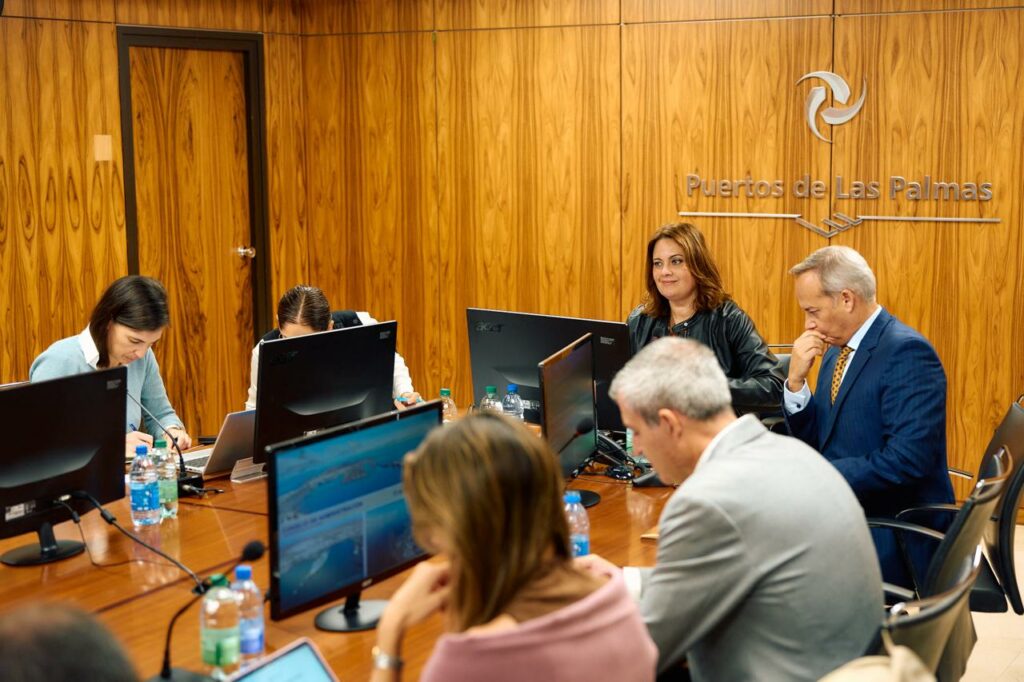
The Las Palmas Port Authority held its ordinary Board of Directors meeting for the month of February this Thursday, a session focused on boosting economic activity, environmental sustainability, updating port services and strengthening legal certainty in the management of public port land.
At the end of the meeting, the President of the Las Palmas Port Authority, Beatriz Calzada, highlighted that “the agreements adopted reflect a management approach aimed at consolidating economic growth, reinforcing environmental sustainability and guaranteeing legal certainty in the use of public port land, with a strategic vision at the service of the Canary Islands and a direct impact on how we want our port to evolve in the coming years: more useful for citizens and more robust in the management of its spaces and services”.
Boosting economic activity, innovation and port logistics
In terms of assets, the Board awarded the contract for the sale of a plot of land located on Avenida de Naos, in Arrecife, in favour of Mr Manuel Borges Martín, moving forward in the optimisation of port assets.
Likewise, a new concession was granted to the Canary Islands Institute of Technology for the installation of a test bank for floating photovoltaic platforms and wave energy generators in the Port of Las Palmas. The concession will occupy 2,109 m² of water surface, 220 m² of submerged space, 38 m² of land and 13 m² of pipelines, with a concession period of 18 years, an annual occupation fee of €11,797.16 and an activity fee of 4% on a minimum business volume of €60,000. This initiative is linked to the development of marine renewable energies and technological innovation within the port environment.
With regard to the recovery and proper use of public port land, the Board resolved administrative eviction procedures to recover mooring berths occupied without an enabling title in the Small Craft Basin of the Port of Las Palmas, including the vessels GOFFIO and BETANA, bringing the total number of evictions agreed to date to 28. This reinforces regulatory compliance and the orderly management of port spaces.
In addition, various administrative appeals related to authorisations, evictions and the use of moorings were resolved through the inadmissibility or dismissal of the appeals lodged, consolidating legal certainty and transparency in the actions of the Port Authority.
In the field of planning, the Board initially approved the valuations of land and water surfaces at the ports of Arrecife and Puerto del Rosario, as well as land affected by maritime signalling in Lanzarote and Fuerteventura. This updates the port economic framework with new reference values for the different land and maritime functional areas, representing a key step towards updating the system on both islands.
The session also agreed on the naming of new spaces in the Port of Las Palmas, with the creation of Juan Socas Betancor Street and the Dockworkers’ Roundabout, in recognition of professional careers linked to the port sector and the essential role of mooring services in maritime safety.
In environmental matters, the Board approved an agreement with the Arrecife Maritime Terminal to promote good practices through incentives in the activity fee, reinforcing the port system’s commitment to sustainability.
Updating port services and passenger assistance
The Board agreed to update tariffs linked to emergency response, rescue, firefighting and pollution control interventions in towing, mooring and waste reception services at the ports managed by the Port Authority. Increases range between 0.614% and 16.57% depending on the service and the port, ensuring alignment with operating costs and maritime safety requirements.
In the area of procurement, the service for passenger assistance and information at the EES/ETIAS border control in the Port of Las Palmas was awarded to the company Forum Activa Canarias, S.L.U., strengthening traveller assistance and control operations within the port area.
Finally, the Board adopted agreements delegating powers that will allow progress to be made on strategic projects, such as the intermodal transport hub at the Port of Las Palmas and the installation of photovoltaic lighting along the seafront promenade in Puerto del Rosario, financed with European Next Generation funds.
With the agreements adopted at this session, the Las Palmas Port Authority continues to strengthen its role as a key infrastructure for the economic, logistical and sustainable development of the archipelago, advancing in innovation, legal certainty and institutional cooperation in the service of the Canary Islands.