
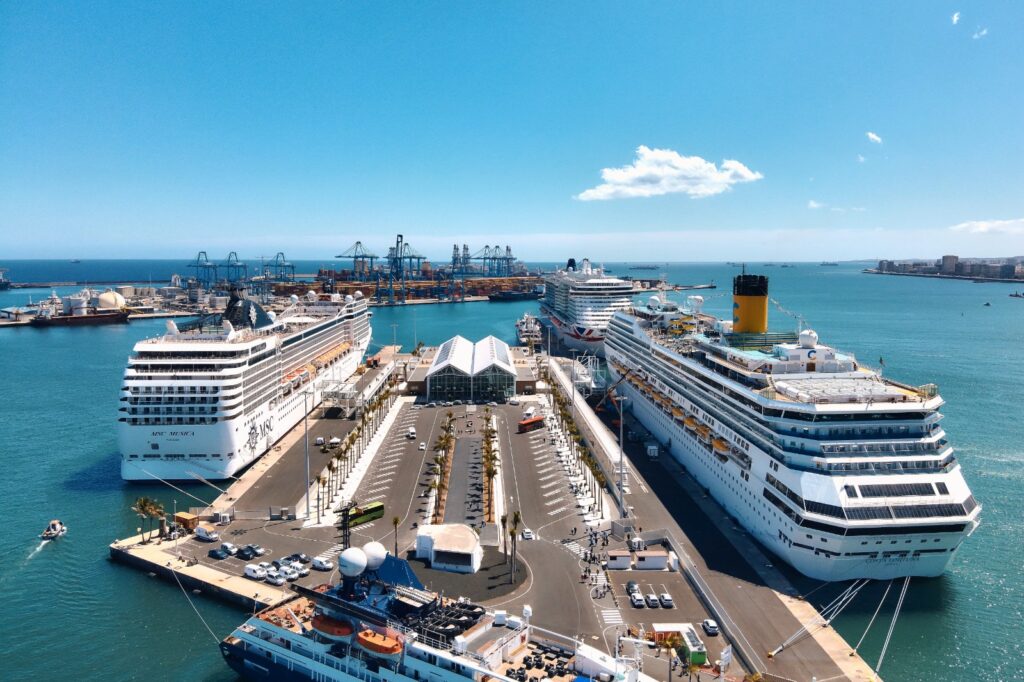
The port system records 888,378 passengers so far this year, up 13.06% from 2025, including 710,072 cruise passengers Total traffic reaches 5,655,540 tonnes, a 4.67% increase, with growth in the ports of Las Palmas, Arrecife, Arinaga and Salinetas Fuel supply also rises by 4.93%, reaching 425,733 tonnes
The Port Authority of Las Palmas closed the month of February with positive results across its main indicators, driven by growth in passenger traffic, the strong performance of cruise tourism, and the upward trend in total cargo traffic across its five ports.
In the January–February period, the ports of the Port Authority registered 888,378 passengers, an increase of 102,614 compared to the same period in 2025, representing 13.06% growth. Within this trend, cruise traffic once again stands out, with 710,072 cruise passengers, 18.31% more than a year ago.
Beatriz Calzada, President of the Port Authority of Las Palmas, highlighted that “February’s figures consolidate the strong start to 2026 for our ports, particularly in passenger traffic and cruise activity, which continues to show very solid performance. At the same time, the growth in total traffic and cargo confirms the strength of our port system and its capacity to continue generating economic activity and connectivity for the Canary Islands.”
Total traffic at the Port Authority reached 5,655,540 tonnes in the year-to-date, a 4.67% increase compared to February 2025, with 252,534 additional tonnes. This figure reflects the overall activity of the system and shows a positive trend. Within this context, cargo represents the largest share, with 5,152,884 tonnes, up 4.25%.
Port-by-Port Analysis: Broad-Based Growth Across the System
The Port of Las Palmas once again accounts for the highest volume of activity, with 4,902,414 tonnes accumulated through February, a 5.36% increase. It is followed by:
| Port | Tonnes | Variation |
| Arrecife | 321,362 | +0.37% |
| Puerto del Rosario | 273,093 | — |
| Salinetas | 106,491 | +5.54% |
| Arinaga | 52,180 | +0.95% |
At the Port of Las Palmas specifically, February data also show a notable rise in passenger traffic, with 503,623 passengers so far this year, 16.22% more than in 2025. Cruise tourism is the fastest-growing segment, up 28.37%, reinforcing the port’s role as a major gateway for maritime tourism in the province.
The port also handled 4,418,393 tonnes of cargo (+5.06%), 424,498 tonnes of fuel (+4.96%), and 669,400 tonnes of Ro-Ro traffic (+8.92%). These figures reflect growth in cargo movement, bunkering services, and roll-on/roll-off operations—three activities closely tied to the port’s daily operations and logistical strength.
Frozen Fish and Fuel Boost February Performance
Among the Port Authority’s key indicators, frozen fish stands out with 50,345 tonnes so far this year, a 57.35% increase compared to the same period in 2025. Fuel supply also rose, reaching 425,733 tonnes (+4.93%), while Ro-Ro traffic totalled 963,135 tonnes, up 4.65%.
Bunkering operations reached 502,627 tonnes, a 9.27% increase, while water supply showed particularly strong growth, with 76,894 tonnes, up 41.77%. Meanwhile, liquid and solid bulk cargo reached 1,832,973 tonnes, a 17.56% increase, driven especially by liquid bulk, which rose 16.99% to 1,752,209 tonnes.